Year 5 · Area of rectangles
What’s the difference between area and perimeter?
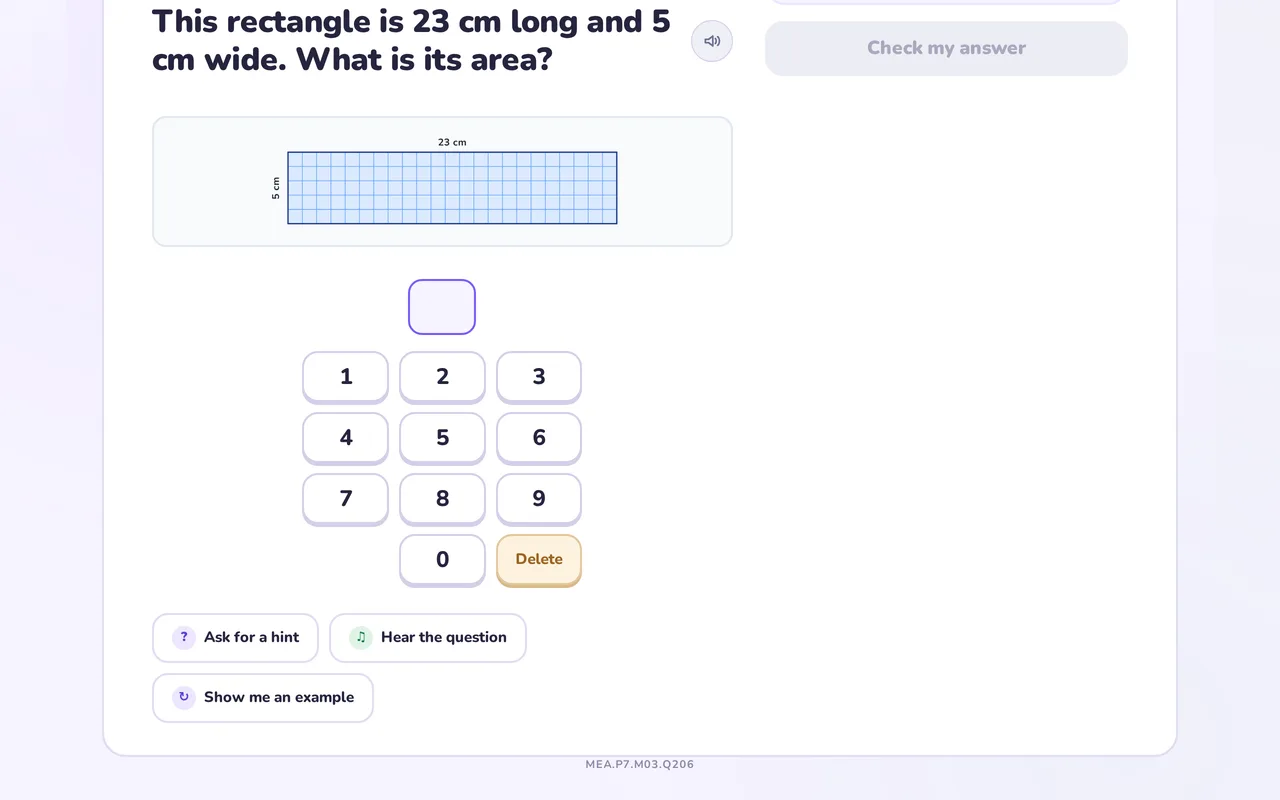
Your Year 5 child is asked for the area of a rectangle 23 cm long and 5 cm wide, and writes 56. Perimeter is the distance all the way around the edge; area is how many squares fill the inside. So 56 is not the area — but it is a useful number, because it tells you exactly what they were thinking.
Why the mistake is smart
A child who answers 56 is not guessing. For years, measuring has meant running a ruler along a line, and the two numbers on the page are side lengths, so adding them up is the natural move.
They have added the long side and the short side and doubled it: 23 + 5 = 28, and 28 doubled is 56. That calculation is correct. It is the distance all the way around the edge — the right answer to a different question.
Naming that first, before you correct anything, takes most of the tension out of the moment.
The fix: the picture that untangles it
Step one — stop measuring the walk, start counting the tiles. Area is not about the journey around the outside. Picture the rectangle as a floor that needs covering in square tiles, and count the tiles that fit inside the border.
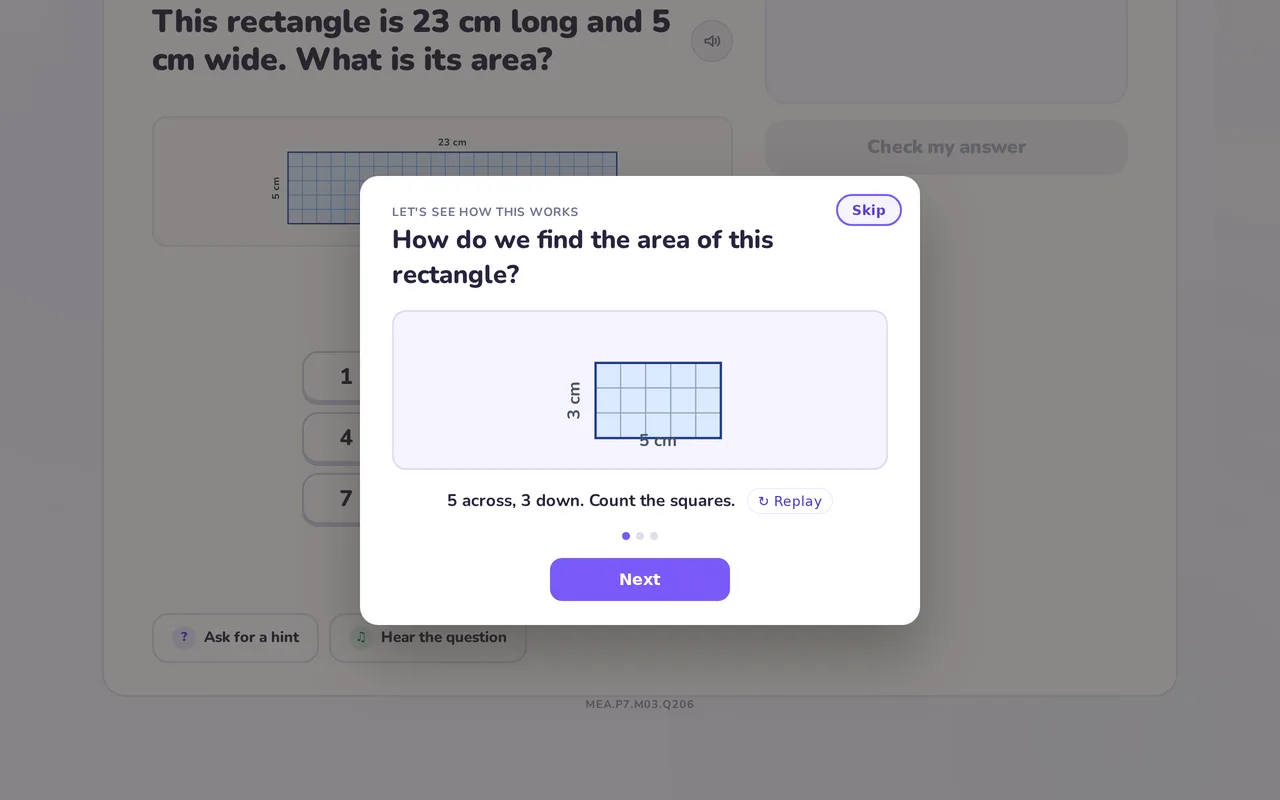
Step two — count one row, then count the rows. Look along the top row and count the squares in it. Then look down the side and count how many rows there are.
Step three — multiply, and say “square”. Instead of counting every tile, multiply the squares in a row by the number of rows. For a rectangle 23 cm by 5 cm that is 23 × 5 = 115 square centimetres. The word “square” is what separates it from a perimeter of 56 centimetres.
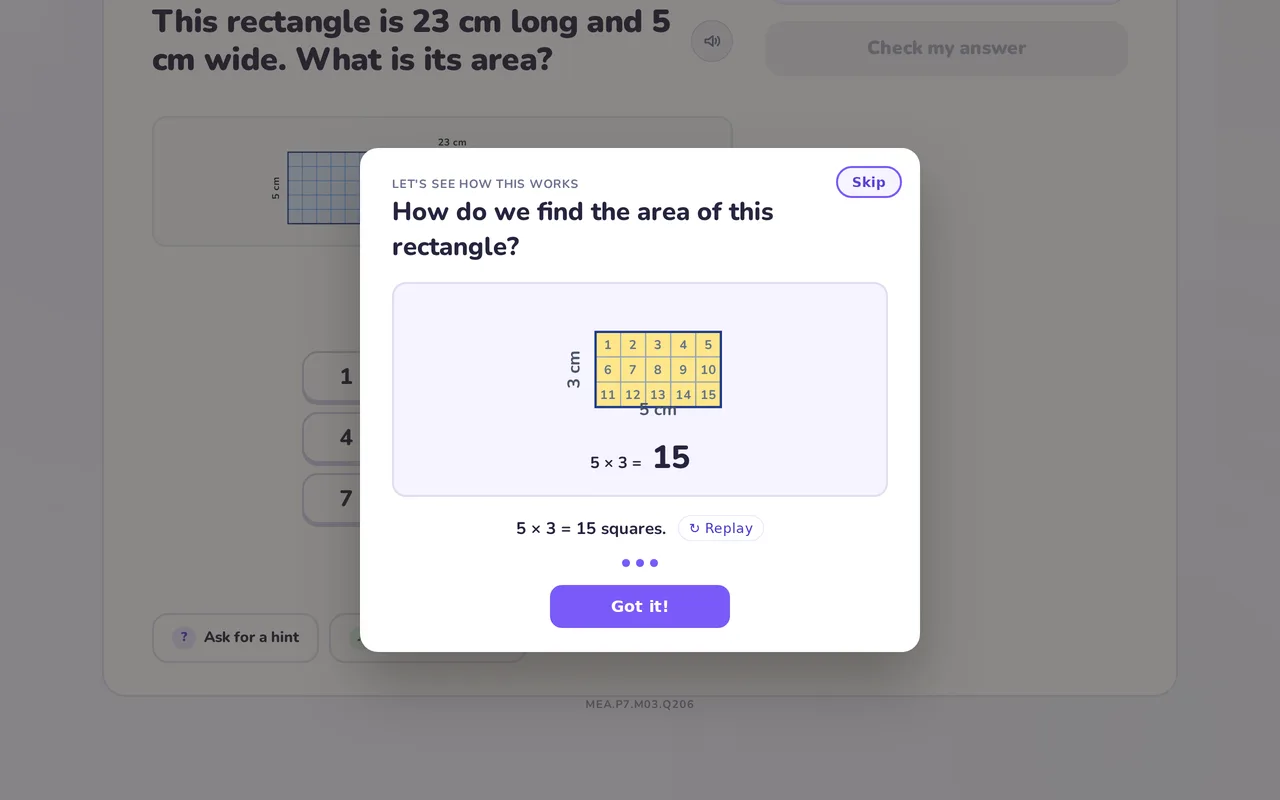
The app’s demo deliberately walks a smaller rectangle, 5 across and 3 down, numbering the squares from 1 to 15 so the counting is visible. It uses different numbers from the child’s own question on purpose, so they still get to finish theirs.
If the shape on the page is a plain outline with no squares in it, draw them in. A child who cannot see the squares is being asked to trust a rule; a child who can see them is being asked to count, and counting is something they already know how to do.
It is worth saying the two answers side by side once, out loud. A rectangle 23 cm by 5 cm has a perimeter of 56 centimetres and an area of 115 square centimetres. One shape, two questions, two units.
What to say tonight
- “Are we measuring the walk around the edge, or the squares that fill the inside?”
- “How many squares are in the top row? And how many rows are there?”
- “Should the answer be centimetres, or square centimetres?”
How SmartMaths handles it
Every one of the 33 Year 5 questions on this skill carries the area-perimeter mix-up as a known wrong turn, so the help is written for it in advance. Ask for a hint here and the first one says: “Area of a rectangle is length times width, not the distance around the edge. Multiply the two sides.”
A wrong answer does not just get marked wrong, either. “Show me how” opens the squares demo at the moment of confusion, and “Explain it differently” re-teaches the same idea another way if the first one has not landed. The rest of the year is on our Year 5 maths practice page.
SmartMaths is very affordable tutor-style maths at home — it explains mistakes the way a tutor would; free trial at smartmaths.ai.
Common questions
How do you work out the area of a rectangle?
Multiply the two side lengths together. That is the same as counting the squares in one row and multiplying by the number of rows.
Why is area measured in square centimetres?
Because you are counting squares that measure one centimetre along each side. It describes flat surface covered rather than the length of a line, so it needs a different unit from the perimeter.
What area and perimeter work does a child do in Year 5?
Year 5 covers 29 micro-skills in our curriculum model, three of them measurement. Children move on from counting squares one at a time to multiplying the sides, and learn to tell area and perimeter apart when a question hands them both.